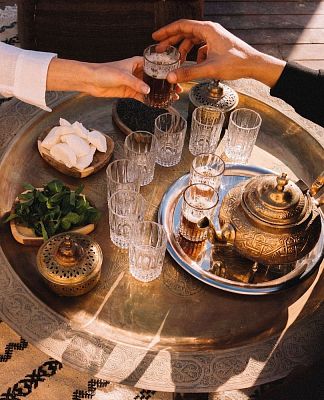
MoroccanTea Is Not a Break from the Negotiation
What Moroccan Diplomacy Teaches Us About Trust, Dignity and Genuine Partnership
Andrea Flimelova| President of the Slovak–Moroccan Chamber of Commerce
A European executive arrives at a meeting with a presentation, a schedule and a clearly defined objective. The Moroccan host offers tea and begins asking about the journey, mutual acquaintances or the guest’s relationship with the country. The visitor may feel that the negotiation has not yet begun. In reality, its most important part is already underway.
In Morocco, it is not only the proposal on the table that is being evaluated. Attention is also directed towards the person who brought it. Who are they? Who stands behind them? Do they understand the environment they are entering? Are they prepared to remain present after the contract has been signed? And will their word still hold when the first complication arises?
This is where business etiquette meets diplomacy. Both are built on trust, continuity, dignity and the ability to understand the meaning behind gestures. If we want to do business successfully in Morocco, knowing the rules of greeting or exchanging business cards is not enough. We need to understand the logic of the relationship.
A Country of Multiple Cultural Codes
Morocco cannot be accurately described through a single cultural label. It is not merely an Arab country, an African country or a close neighbour of Europe. It is all of these at once.
The Moroccan Constitution defines the country’s national identity as a convergence of Arab-Islamic, Amazigh and Saharan-Hassani components, enriched by African, Andalusian, Hebraic and Mediterranean influences. At the same time, it connects the country’s Muslim identity with openness, moderation, tolerance and dialogue between cultures.¹
This is not simply an appealing description of the country. It is one of the keys to understanding Moroccan diplomacy. Morocco can engage with Africa as an African nation, with the Arab world through shared history and religion, with Europe through commercial, linguistic and Mediterranean ties, and with the wider world as a stable partner at the crossroads of regions.
For a foreign businessperson, this carries an important lesson: they are not entering a one-dimensional environment. Someone who respects the many layers of Moroccan identity demonstrates cultural awareness and preparedness. Someone who reduces the country to the desert, the souk or a French-speaking market reveals that they have not yet understood it.
Trust Comes Before the Transaction
In European business, we often assume that professionalism means separating the personal from the professional. In Morocco, these two dimensions are not divided so sharply. A personal relationship helps answer the question of whether a professional commitment can be trusted.
The current country commercial guide published by the U.S. International Trade Administration states that close working relationships are often essential to concluding business deals in Morocco. Trust and mutual respect are developed gradually, and a personal presence in the country can be a significant part of a successful market-entry strategy.²
This explains the value of a trusted introduction. A credible mutual contact does more than open a calendar. They transfer part of their own reputation to the new partner. That is why the right introduction, a personal meeting or a return visit to Morocco may achieve more than a series of perfectly written emails.
In my work between Slovakia and Morocco, I repeatedly see that a partnership does not begin with the signing of a memorandum. It begins much earlier—with the way we arrive, listen and conduct ourselves in the time between individual meetings.
Tea as Part of the Negotiation
Moroccan tea is perhaps the country’s best-known symbol of hospitality. In a business setting, however, it is more than a charming folkloric detail. It creates time and space in which people can get a sense of one another without the pressure of a formal agenda.
Official business guidance recommends graciously accepting an invitation to tea or coffee. Hospitality helps build trust and a friendly relationship, which may subsequently support the business objective.³ The greatest mistake, therefore, is not failing to know the precise ritual of pouring the tea. The greater mistake is behaving as though the tea were an obstacle standing between us and the real work.
The work is already taking place. The host is observing whether we know how to be present, whether we show genuine interest and whether we respect their pace. At the same time, the guest is gaining valuable information: who sets the tone of the conversation, whose views receive the most attention, which topics create openness and which make the communication more cautious.
Tea is therefore not a break from the negotiation. It is one of the environments in which people decide whether the negotiation can proceed at all.
Continuity Is More Valuable Than Speed
Morocco’s diplomatic style cannot be separated from the role of the monarchy. The Constitution defines the King as Head of State, symbol of national unity and guarantor of the permanence and continuity of the State. The King also ensures respect for the country’s international commitments and, as Amir Al-Mouminine—Commander of the Faithful—holds a distinct religious authority.⁴
This continuity shapes the way Morocco builds its international relationships. Royal visits, strategic agreements and long-term projects create a framework that extends beyond a single electoral term or business opportunity.
The same principle can be felt in business. Speed may be an advantage, but it does not create credibility on its own. Credibility is built through the willingness to return, to honour an agreed next step and to remain a reliable partner even during the less visible stages of cooperation.
A company that arrives pushing for an immediate decision and then disappears for several months after the meeting sends a contradictory signal. A partner who expresses thanks, sends a clear summary and continues the conversation without unnecessary pressure demonstrates an understanding of the value of the relationship.
Dignity Is Part of the Outcome
Every culture has its own appropriate way of expressing disagreement. In Morocco, preserving dignity and respecting a person’s position within the group carry particular importance. This does not mean that problems are left unaddressed. It means that the manner in which they are raised may determine whether the problem is resolved or turns into a damaged relationship.
Correcting someone publicly, interrupting a senior participant or pressuring them to admit a mistake immediately may have a far greater impact than a foreign guest expects. A sensitive objection can often be raised more effectively in a calm manner, framed as a question or moved into a smaller, more private conversation.
It is equally important to know how to interpret politeness. A pleasant tone, a smile or a comment that a proposal is interesting does not necessarily indicate that a decision has been made. An experienced partner also listens for what has not been confirmed: who is expected to take the next step, who must approve the proposal and whether a specific date has been agreed.
Respect, therefore, does not mean passivity. It means being able to communicate clearly without depriving the other party of their dignity.
Language Communicates Both Closeness and Precision
Morocco’s constitutionally recognised official languages are Arabic and Tamazight. French, however, remains widely used as a working language in business, administration and public procurement. English is gaining importance, particularly among younger, internationally oriented professionals.¹ ³
A brief greeting in Darija can create a sense of human warmth. A professionally prepared document in French can demonstrate that we have made the effort to understand our partner’s working environment. Most importantly, the language of the meeting should be confirmed in advance, and approximate understanding should never be relied upon in technical or legal matters.
Language is more than the translation of words. It carries levels of formality, attitudes towards authority and cultural nuances. A professional interpreter sometimes protects more than the accuracy of the content. They also protect the relationship itself from misunderstanding.
Partnership Instead of a Quick Sale
One of the most compelling principles of modern Moroccan diplomacy can be found in the country’s approach to Africa. In his speech marking Morocco’s return to the African Union, King Mohammed VI described South–South cooperation as sharing what a country possesses without ostentation. He spoke about the transfer of expertise, education, strategic projects and shared growth.⁵
This logic has direct relevance for companies entering the Moroccan market. An offer based solely on the question, What can we sell?, is usually less powerful than one that also answers the question, What can we create together?
This may involve engaging a local partner, providing professional training, transferring technical know-how, creating employment or generating long-term operational value. Not every project needs to include all these elements. It must, however, provide a credible explanation of how both sides will benefit.
A Moroccan partner can very quickly sense the difference between a genuine interest in the country and an interest limited to securing a contract. This is where a business presentation becomes a diplomatic act: it articulates not only one’s own ambition, but also a shared interest.
Topics That Leave No Room for Improvisation
Cultural intelligence also means recognising which subjects should not be approached casually. The monarchy, religion and territorial integrity are among the fundamental pillars of the Moroccan state. Western Sahara is a sensitive matter of foreign policy and, at the same time, the subject of differing international positions.
If a political topic is unrelated to the mandate of the meeting, there is no need to turn it into casual conversation. If it is relevant to the project, precise diplomatic and legal language should be used, the positions of the parties involved should be understood and oversimplifications should be avoided.
Restraint in this context is not a lack of openness. It is a sign of respect for the gravity of the subject.
A Warm Relationship Still Requires a Precise Commitment
The emphasis placed on relationships may create a dangerous misconception for a foreign visitor: the belief that personal closeness replaces formal certainty. It does not.
Business guidance for Morocco combines two recommendations that must be read together. Accept hospitality and invest in building trust. At the same time, conduct due diligence on the business proposal and document all commitments, as a verbal agreement may not provide legal protection.³
The best follow-up is therefore not a cold administrative addition to a pleasant meeting. It is a way of protecting trust from differences in memory and expectations. It should briefly confirm what the parties agreed, who is responsible for the next step, the applicable deadline and which questions remain open.
Relationship and precision are not opposites. In a strong partnership, they reinforce one another.
Seven Rules for Your Next Meeting
- Arrive with respect for the country, not merely knowledge of your own product.
- Understand the standing of the participants and address them using the appropriate titles.
- Do not rush the conversation that precedes the agenda. It is also part of the decision-making process.
- When expressing disagreement, protect the other person’s dignity and remain factual.
- Do not automatically interpret politeness as agreement. Confirm the specific next step.
- Demonstrate mutual benefit and your willingness to remain present over time.
- After the meeting, transform the positive atmosphere into a clear written framework.
The Highest Form of Etiquette
Business etiquette is sometimes reduced to the correct greeting, appropriate clothing, business cards or seating arrangements. All these details may be important. On their own, however, they do not create trust.
The highest form of etiquette is the ability to make a partner feel that we understand the world in which their decisions are made. That we respect their identity and dignity. That we have not come merely in pursuit of a quick result. And that our word will carry the same weight after we have left the meeting room.
That is why tea is not a break from the negotiation. It is a moment in which not all the terms of the deal have yet been discussed, but its most important condition is already being decided: whether we can trust one another.
Sources
- Constitution of the Kingdom of Morocco 2011, Preamble and Articles 1–5. Constitute Project.
https://www.constituteproject.org/constitution/Morocco_2011 - Morocco Market Entry Strategy. U.S. International Trade Administration, updated 31 July 2025.
https://www.trade.gov/country-commercial-guides/morocco-market-entry-strategy - Morocco Business Travel, sections “Business Customs” and “Language”. U.S. International Trade Administration, updated 31 July 2025.
https://www.trade.gov/country-commercial-guides/morocco-business-travel - Constitution of the Kingdom of Morocco 2011, Articles 41 and 42. Constitute Project.
https://www.constituteproject.org/constitution/Morocco_2011 - Full Speech of HM the King at the 28th African Union Summit. Official Portal of the Kingdom of Morocco, 31 January 2017.
https://www.maroc.ma/en/royal-speeches-and-messages/royal-speeches/full-speech-hm-king-28th-african-union-summit
Morocco Crafted by Hand
On a heritage that does not belong only to the past, but remains present today.
Andrea Flimelova| President of the Slovak–Moroccan Chamber of Commerce
Some doors make you pause before you open them. Behind the high walls of the medina, you cannot see what awaits you. Then the door gives way and you step into a courtyard. The noise of the street stays behind. Water in the fountain, light on the walls and the quiet of the house create an entirely different rhythm.
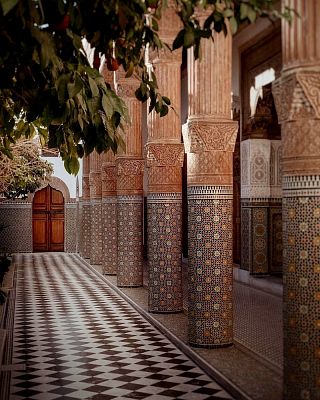
You feel as though you have entered another world. Only after a moment do you begin to notice what this world is made of. A carpet beneath your feet. Zellige on the walls. A lantern above you, drawing new patterns with light. Beauty welcomes you first. But behind that beauty are people.
For me, this is where a deeper understanding of Morocco begins: with the question of who made these things, what they had to learn and to whom they will pass that knowledge on. Moroccan heritage is more than what we admire in historic palaces or take home with us. It is a living relationship between people, materials and place.
Carpets: worth lingering over
A carpet may first catch your eye because of its colours. Then you touch its surface and realise how much time it holds. Each row took shape gradually. Someone chose the fibres, adjusted the tension, returned to the pattern and decided when the work was complete. A photograph shows us the finished piece; meeting the person who made it helps us understand the work.
The Moroccan National Tourist Office notes that carpets vary by region and that they have traditionally been made predominantly by women, including through techniques rooted in Amazigh culture. We should therefore be careful about speaking of a single “Moroccan pattern”, as though an entire country had only one story. Every carpet has an origin, a method of making and people whose names often never appear on its label.
If we ask only about the price, we learn little. If we ask about the place and the hands that wove the carpet, the conversation changes.
Zellige: beauty assembled piece by piece
In a courtyard, daylight moves across the mosaic. You see one shade in the morning and another in the afternoon. From a distance, zellige appears to be a seamless pattern. Up close, you see the individual glazed ceramic pieces, each of which had to find its precise place.
This beauty can captivate you in an instant. The skill that creates it cannot be learned in one. In its description of the Medina of Fez, UNESCO writes about construction and decorative techniques in which local knowledge meets Andalusian, Oriental and African influences. It also emphasises the importance of preserving traditional architectural and decorative skills if the historic city is to endure.
When we look only at the wall, we see a pattern. When we look at the craftsperson, we see the knowledge without which that pattern could not continue.
Lanterns: when light becomes part of a home
In the evening, the room changes again. Light passes through a lantern, casts shadows on the walls and creates a feeling you may remember longer than the room’s dimensions. The lantern is more than an object. It helps shape the environment around it.
The Moroccan National Tourist Office includes lanterns and candlesticks among the products of traditional metalwork in cities such as Marrakech, Fez and Safi. Hold one of these objects and you begin to notice its shape, its joins and its surface. Soon you want to know about the workshop where it was made. Admiration for an object becomes attention to the person behind it.
Jewellery: heritage worn close to the body
Jewellery does not remain on a wall or a floor. People carry it with them. It can be a gift, an adornment, part of a celebration or a way of expressing belonging. Its meaning also depends on the wearer and the occasion; we cannot read it from its shape without understanding its context.
The Moroccan National Tourist Office describes Amazigh jewellery and the production of silver jewellery in Tiznit, Taroudant, Essaouira and other cities. UNESCO lists the arts, skills and practices associated with engraving on gold, silver and copper as intangible cultural heritage, in a multinational inscription that includes Morocco. The recognition concerns the skill and its transmission. It does not mean that every piece of jewellery or every lantern has its own UNESCO inscription.
Behind the beauty of a piece of jewellery is a decision about what to preserve in the material and what to create from it. Behind that decision are often years of learning.
The hammam: heritage you cannot take home
You can buy a carpet. You can hang a lantern in your own home. From a hammam you bring back something else: the memory of warmth, water, cleansing and time that, for a while, you no longer need to measure. It is easy to see it only as a pleasant experience during a journey. Yet the traditional public hammam is also part of the everyday lives of the people who return to it.
The Eco-Hammam research project describes historic hammams as living social heritage: places for hygiene, wellbeing and encounters across generations. It also warns that some traditional hammams are giving way to spa businesses under the pressure of tourism. That question deserves our attention. To appreciate the ritual, we need to understand its place in the life of the community.
The hammam reminds us that heritage lies not only in what Morocco has made. It also lies in how people live.
What does this mean for partnership?
When we speak about working with Morocco, we naturally speak about markets, quality, design and opportunities. Craft gives us a reason to look a little deeper: to ask where a product comes from, who holds the knowledge, who did the work and who will benefit from a new project.
This does not mean confining tradition to the past. Moroccan creators and craftspeople also work for contemporary homes, architecture and design. Slovak companies in these fields, as well as in hospitality and the creative industries, may find valuable opportunities for collaboration. But the quality of that collaboration begins before we select a beautiful pattern. It begins with a conversation with the people who know how and why it was made.
The Slovak–Moroccan Chamber of Commerce connects our countries by making space for this kind of understanding. When we step through the door of a Moroccan home, the country first lets us feel its beauty. If we stay with it a little longer, we begin to see the hands and knowledge that give it form.
And then a visit can become a conversation. A conversation can become respect. And respect can become partnership.
Sources: Moroccan National Tourist Office – traditional craftsmanship; UNESCO – Medina of Fez; UNESCO – engraving on metals; Eco-Hammam research project.